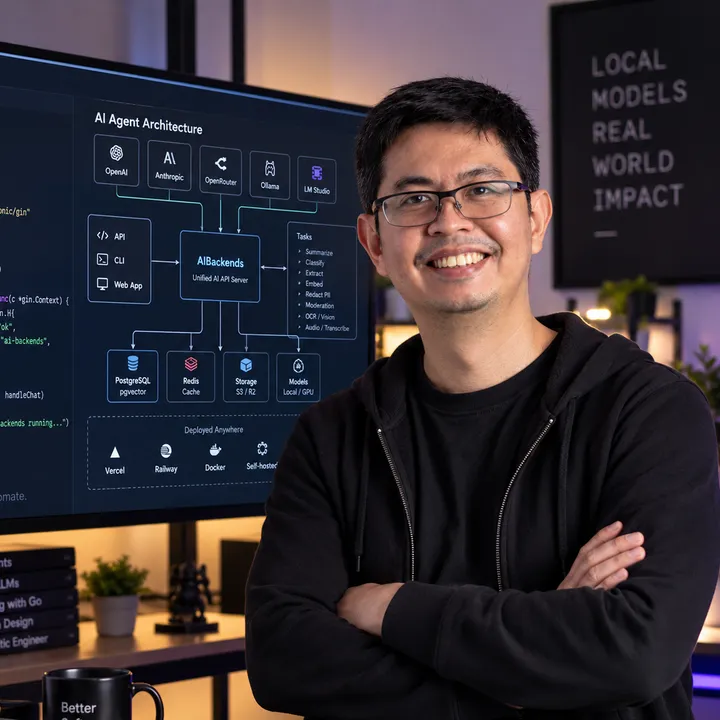
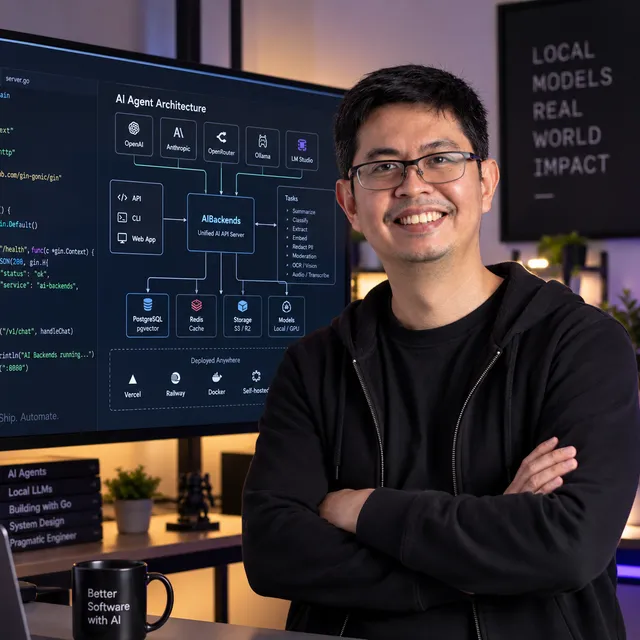
No slides, no hype. I teach by building live on YouTube and X: AI agents, local models, and AI workflows, mistakes included. Join live and ask questions in chat, catch the replays on YouTube, and follow on X for the latest AI updates.
people trained through talks, workshops, and mentoring
2.2k+
GitHub stars on the open-source tools I teach with
25+
years shipping software, the context behind every video
Workshops & talks
Bring an AI workshop to your school or organization.
The same way I teach on the livestreams, run for your students, faculty, or team: hands-on sessions on AI Agents, Local Models, and AI Workflows, in plain language. Online via Zoom, with on-site options on request.
OpenAI introduced (Oct 26) GPT-6.1 Terra, a faster model for visual reasoning, writing, and computer use such as reading a screen, filling forms, and working in desktop apps. Standard API prices are $1 per million input tokens, $0.05 per million cached input tokens, and $5 per million output tokens, which OpenAI says is 50% lower than GPT-5.6 Terra and GPT-6.1 Sol. It is available to Plus, Pro, Enterprise, and Edu users in ChatGPT Work and Codex, and in the API as gpt-6.1-terra. On Agents’ Last Exam at medium reasoning, OpenAI says Terra scores 15 percentage points higher than GPT-5.6 Terra at about one-third the cost, matches GPT-6 Astra at about one-tenth the price per token, and at max effort is over three times as token-efficient as Claude Opus 5.5 at one-fourth the price per token, about 9× lower cost per task. OpenAI also says it finishes tasks more than three times faster than GPT-6 Astra and GPT-6.1 Sol. On an internal error-prompt set, it says the error rate fell from 53.6% for GPT-5.6 Terra to 16.7% at low effort, and to 4.3% at maximum effort. On Terminal-Bench 4.0 at maximum effort, OpenAI reports 50.3%, more than double the 21.5% it cites for GPT-5.6 Terra, and says GPT-6.1 Sol and GPT-6 Astra remain stronger on the hardest coding tasks. OpenAI says Terra meets the Critical cybersecurity threshold in its Preparedness Framework and keeps the GPT-6 Astra safeguards. Those scores and prices are OpenAI’s. Distinct from GPT-6 Astra and from GPT-5.6 Terra.
Anthropic said (Oct 26) it filed a Form S-1 with the U.S. Securities and Exchange Commission for a proposed IPO of Class A common stock on the Nasdaq Global Select Market under the symbol ANT. The share count and price range are not set, and the registration statement is not yet effective. The preliminary prospectus shows revenue of $16.286 billion for the six months ended June 30, 2026, compared with $1.163 billion a year earlier, and $4.585 billion for all of 2025. Net loss for that 2026 half was $80.748 billion. Operating loss was $693 million, down from $2.135 billion a year earlier. The filing says $72.388 billion of the half-year result is a non-cash change in fair value of convertible notes, derivative liabilities, and SAFEs, tied mainly to a higher enterprise valuation. It also reports more than 11,900 customers with at least $100,000 of trailing-twelve-month revenue, more than 1,900 with at least $1 million, and about 250 with at least $10 million, plus trailing-twelve-month revenue per employee of over $6.6 million as of September 30, 2026. Anthropic is a Delaware public benefit corporation. Its Long-Term Benefit Trust would elect a majority of the board through Class T stock, and a founder company would hold Class F stock with 50.1% of the general stockholder vote and no economic rights. These figures are from the filing. The announcement is not an offer to sell shares. Distinct from earlier confidential-filing reports.
Meta announced (Oct 26) a financing plan of up to about $95 billion to support AI infrastructure and personal superintelligence. About $35 billion is in concurrent underwritten offerings: $22.5 billion of Class A common stock sold through forward sale agreements with Morgan Stanley and Goldman Sachs, and about $12.5 billion of depositary shares (250 million shares, each 1/20th of a Series A mandatory convertible preferred share). Meta does not expect cash from the common-stock sale until the forwards settle, on dates it can set on or before November 19, 2027. It also plans an about $60 billion at-the-market program after its previously announced Class C shares start trading, which it does not expect before the first quarter of 2027. Meta says it has not signed an agreement for that program. NVIDIA, AMD, and Broadcom have indicated interest in buying up to $5 billion of the Class A shares in total. Meta says those indications are not binding. Meta expects 2026 capital expenditures of $135 billion to $145 billion, says it is building four superclusters of more than 1 gigawatt each, and reported third-quarter revenue of $64.6 billion, up 26% year over year, and net income of $9.9 billion. It also says more than 10 million people in the U.S. and Canada started using Muse in the early weeks after launch. These figures are Meta’s. This is not an offer to sell securities. Distinct from Meta’s October 21 earnings release.
Source: Meta Investor Relations
Updated October 26, 2026
What I teach: AI Agents, Local Models & AI Workflows
AI Agents
Autonomous agents with memory, tools, and skills that do the work, not just chat about it.
I teach AI Agents, Local Models, and AI Workflows to people who want to use AI, not just read about it. Before the channel: senior engineering roles at Standard Chartered Bank and Ohmyhome (Nasdaq), then a run of AI products built and shipped end to end. That's why every video, talk, and post is grounded in what actually ships.
Livestreams AI builds on YouTube and X
Speaker at NTU Singapore, PSIA, and DICT Philippines
300+ trained through workshops and mentoring
Open-source maintainer: Codex orchestrator, Local Evals, Agent Monitor
Subscribe on YouTube for the next livestream and follow on X for the latest AI updates. Want a workshop for your school or organization, or help with a product? Book a call.